Author: Wan Ahmad Saifuddin
The Start of Exploring Foldies
The very concept of a folding bicycle was intriguing to me; I had always been more of an urban cyclist, and to the surprise of many I actually like to cycle in the city and suburbs. There is a different sense of adventure, of even urgency that would be missing from coasting down a meandering bucolic path. It may have to do with the fact that I was very much a city boy, born and bred in the Klang Valley for most of my life. To cycle in the city was a matter of… survival. A slightly perverse sense of high…
I had bought a bicycle rack that attaches to the back of my Kia Sorento for weekend rides at Lake Gardens. The preparation of hooking up the rack and transferring 3 bicycles (one Proton T-Blaze rigid frame Mountain Bike which was my father’s, which he received as a result of previously co-owned a Proton retail outlet, an XDS aluminium-frame single-speed boy’s bike purchased from Bangi and a Toys-R-Us pink Barbie girls one) from their suspended hooks at the car porch, which usually takes more that 30 minutes, more often than not discourages the thought of even having the excursion. A folding bike, now that’s a different proposition! From my desktop research, it only takes some 20 seconds to fold a bike and carry it into the boot! The possibilities beckon…
Folding bikes have had a long history, and it is a little too long to relate it here, but here’s a link for those who’d like to know. I focused instead on conducting extensive research both online as well as visiting various shops that had been checked out online. One of my most often referred-to blog site is Sam Cheong’s excellent “The Samosaurus Chronicles“, probably the most exhaustive folding bike blogs there is, and a Malaysian one to boot. It was through his site that I developed a keen interest for Dahon and Tern bikes. Today, the Dahon name is synonymous with folding bikes after coming out with its first production in 1982 by Dr. David Hon, a physicist; Tern is owned and developed by his son, Joshua Hon; fortunately, the legal dispute between the two companies (one of the impact was that Dahon bicycles were released, for a period of time, as Dr. Hon) was settled and we can now enjoy superb products and new models from both companies.
![]() |
| Polygon Urbano 3.0 |
![]() |
| Rodalink Bangsar |
The only time I really had to visit bicycle shops were lunchtimes, in-between meetings or sometimes on the way back home, so that was what I did. The first was the closest to my father’s house in Bandar Baru Bangi called Ogen Cycle, where I saw the Polygon Urbano 3.0 (black) which was pretty appealing, more so than the various XDS folding bike models that they carried, and it even came with a carrying bag. Closer to my house, I had visited Rodalink Bangsar and was impressed by the range of folding bikes that they carried, inlcuding Polygon, Dahon and Tern. Early on, I had my eye on a Dahon Jetstream P8, mainly because of its dual-suspension system although its almost RM4k price was disconcerting. My infatuation with Dahon bikes began.
![]() |
| Dahon Jetstream P8 |
IN SEARCH OF COHERENCE: Attempts at Understanding the Quran Holistically
This post originally appeared on my Facebook Notes. It has been slightly modified for this blog.
Having had conversations with so many Muslims about Islam and then asking for Waze-like directions, they often recommend one to read this or that book. Nothing quite wrong with that; I consider the tomes of Charles le Gai Eaton, Muhammad Asad and Khalid Baig, among others, to be inspirational and informative. However, some of these voracious readers of Islamic books more often than not, for whatever reason, neglect the mention of THE Book, from whence all about Islam is derived, the very foundation of the Way of Life. But I may understand why, as that was how I was before.
Not many people treat the Quran as a book. It is often referred to in times of calamities, when one seeks solace or during religious ‘ritualistic’ practices often ingrained in Islamic cultures. It is often placed on high shelves, a thing that Muslims MUST have, but not often used or actioned upon. Maybe, in looking at it as a book, one may be able to glean much more from it.
The Quran is not like any other book that one would be used to. There is no official Preface or Introduction, there is no outwardly discernible order of the Surahs, and no real conclusion or summary. To make matters more difficult, various Ayat of the Surah were revealed at different times, and their arrangement may even seem haphazard, or even almost random. The intonation of the Surahs, according to the rules of tajweed, can sometimes seem staccato.
My search for meaning in the Quran started with the old Yusuf Ali translations (the new ones published by IBT, regrettably, do not contain an introductory poem summarising the surah at the beginning, unlike the earlier editions). One gets a better appreciation with the translation than without, although if one were to ask me “What was that Surah about?”, I would flounder. Yes, Al-Fatihah was the Opening Chapter of the Quran, it went by many names, including “The Seven Oft-Repeated Verses”, it is a necessity to recite it in Solat, it can even be a cure for sickness (based on hadeeth), etc, etc. Those were merely observations of the surah and its use, but not its essence.
It was more difficult to me when I wanted to understand its concept, its underlying framework, and what lessons one could derive from the, well, oft-repeated verse. A year attempting to study Arabic at UIA (weekly night classes) and some excellent teaching by a Yemeni teacher (though lessons were stopped after a couple of months) did not allow for a discernably better elucidation. I also started collecting many other English translations of the Quran, including Maududi, Syed Qutb, Muhammad Asad, Pickthall, Muhsin Khan and Ibn Katheer (Abridged 10-volume Darussalam set). While Syed Qutb, the poet that he was, eloquently explained the overall gist, and Asad delved much more deeply into language (with Bedouin and Arabic poetry as basis of some translations), this classically-trained architect mind demanded a more coherent framework. M. Azmi’s “The History of the Quranic Text” did yield some understanding of its journey to become an agreed standard version at the time of the third Caliph Uthman Al-Affan radhiallahuanhu (and shedding some light on the Ibn Mas’ud version) as well as the naming of the various Surah, my hunger was still unsated.
Earlier this year, during some casual browsing at my favourite tome-stores in KL, I chanced upon three English translations that I have not come across before. Interestingly all three were on the first two Surah of Al-Fatiha and Al-Baqarah: the first was Irfan Ahmad Khan’s “Reflections on the Quran”, followed by Mahmoud M. Ayoub’s “The Quran and Its Interpreters: Volume 1” and finally Amin Ahsan Islahi’s “Pondering Over the Quran”. Khan’s book was published by The Islamic Foundation, UK and he does a commendable job of grouping parts of the surah into themes. While this is not new, there seems to be a fair amount of clarity in his choices, which I found more compelling than Muhammad Al-Ghazali’s “A Thematic Commentary of the Quran”. Ayoub’s book was rather interesting as it looked at many interpreters, including the Sufi and other sources, even Syiah (rarely one gets a glimpse into their exegetical works in comparison to Sunni sources). The one that really opened my eyes, however, was Islahi’s “Tadabbur”.
Islahi’s book was originally in Urdu, and was translated into English by Mohammad Saleem Kayani in 2006. Islahi’s methodology was borrowed from his teacher, Hamiduddin Farahi, and revolved around the concept of nazm or “coherence”. Unlike other scholars like al-Khattabi, al-Baqillani, al-Jurjani and az-Zamakhshari, who had earlier also utilised the concept of nazm mainly through the relationship of words and meaning, or Razi who argues it brings to light many subtleties (lata’if) of the Quran, the Farahi-Islahi scheme of nazm forms a quintessetial foundation to the message and meaning of the Book. They put forward the idea that every surah has a central theme (‘amud) which unifies the surah, and that there is a logical unity and coherence to all the surah according to they way they are arranged in the Quran. In addition, Islahi posits that there are seven distinct groups of surahs in the Quran with each group having their own distinct ‘amud (as opposed to Farahi’s nine), and in each group the Makkan blocks of surahs always precede the Madinan blocks. And here, for the first time in my life, there was a conceptual framework on the structure and coherence of the Quran right before me.
Being the Gestalt geek, I also wanted to know whether there is any verification of Islahi’s work. It was at Kino Singapore that I came across Muntasir Mir’s “Coherence in the Quran: A Study of Islahi’s Concept of Nazm in Tadabbur-i Quran”. To me, this was like finding the Oscar-winning documentary called “The Heart of Darkness: A Filmaker’s Apocalypse” which detailed Francis Ford Coppola’s journey and challenges in making one of my all-time favourite movies, “Apocalypse Now”. Here was a critical analysis of Islahi’s work, and even compared the concept of nazm against other exegitical methodologies such as asbab al-nuzul or “Reasons for Revelations” and even ponted out the potential weaknesses of Islahi’s method. In the end, Mir still gave Islahi’s work a clear nod as it weathered the many tests he had subjected it to.
It is my fervent hope that this journey down the road of Quranic comprehension and assimilation may be of use to other fellow travellers. Combining Islahi with the efforts of Nouman Ali Khan in Bayyinah TV and Suhaib Webb’s exposition of Al-Baqarah on Reflections, TV Al-Hijrah, as well as other sources that we may find along the way, I hope to unravel the meaning of the Quran as a guide for this little life of mine. In the end, we hope to fulfil what is demanded of us, as stated in Surah Al-Dhariyat (51:56) “I have only created Jinns and men, so that they would worship Me”. And what better way of worship, or at least alongside the fardh or compulsory tenets, than understanding, assimilating and actionising the Quran. One is also reminded of Abdullah ibn Umar, son of Umar Al-Khattab radhiallahuanhu who took 12 years to memorise Surah Al-Baqarah as he could not proceed to memorise the next ayat until he had understood and practised what was asked of the previous ayat. Subhanallah!
Then again, I have always said that when one consumes, it is often meaningless if one does not produce something out of that consumption. So begins my own journey with the Quran. Again.

Origins! Part II
The last post started with the declaration of the cycling bug’s return; ironically it is the flu bug that is currently threatening to keep me company!
After my Pertama Complex and Sungai Wang days, I had a 2-year break from cycling, firstly due to taking an Intensive English Programme at KPP/ITM Subang Jaya, and thereafter 2 years of A-levels at Portora Royal School, Enniskillen. However, my entry into St. Catharine’s College, Cambridge necessitated a bicycle. How could one not ride in the Fens? Fortunately I did not have to scrounge up a battered bike from the town, as my eldest had brought home a fine silver Trek 1000 after she had graduated from Illinois. The tires hitting the Cantabrigian roads marked the beginning of its service for the next 6 years.
| A similar Trek 1000 (image from 3.bp.blogspot.com) |
I still remember pushing the Trek for the very first time into Ben Hayward Cycles located just to the left of Catz on Trumpington Street; the guy working on another bike stared at it – there was no other Trek, to his knowledge, that existed in UK at the time, and that was the first time he had seen one! You could certainly guess how chuffed I was, and the swagger with which I walked for the rest of the day. A quick look at the shop’s website today would show that they now proudly carry Trek!
![]() |
| Serving Cantabrigians since 1912 |
In Cambridge it took me to all my normal haunts – the Cambridge Mosque for Friday prayers and Bosphorous’ Kebabs or Chicken n Chips soon after, Shahidan’s place near the Schlumberger Centre with his apple tree in the backyard, Comics Showcase for my weekly graphics & prose inhalations, and the art shop near Grafton Centre across Parker’s Piece for my architectural presentation supplies. The longest trip was when a group of us went to the Imperial Air Museum in Duxford, though the flat Fens made it fairly effortless.
The Trek continued to serve me well in Edinburgh from 1992-1994 although it was really as an urban commuting vehicle. Though the roads in Scotland’s most metropolitan city were much more challenging, the Trek was very much up to it, flying often its often-cobbled streets, especially at the Royal Mile. It’s lithe aluminium body made it easy for me to carry it up two stories of the semi-hemispherical shaped staircase of my shared flat off East Preston Street, and ended up being used by my housemates once I had left.
After a 20-year lapse, I caught the cycling bug again. Malaysia might well be considered to have non-optimum weather for cycling, as the sweltering sun, high humidity and oft monsoon-like rains ensured that one would only get to one’s destination with copious perspiration entrapped within whatever fabric that adorned one’s back! So it was with a pinch of amusement that I noted so many cyclist during one of the KL Car-Free days riding various types of two-wheelers; but what really caught my eye was the folding bike.
![]() |
| A Dahon Jetstream P8 Dual Suspension |
BLOG SHOPPING: In Search of My Braindump Site/s
Peace!
So I had decided that 2015 would be my year of writing, and thought I’d start a little earlier to give myself a little ramp up the runway. This exercise would also be to test various blogging platforms after a hiatus of approximately 5 years as well as for the purposes of potentially integrating blogs at my university (unitar.my). My first and only blog was started in 2004 focusing on Islam in Kuala Lumpur, and then I migrated to using Facebook Notes, mainly to know who actually read my blogs (blogger didn’t provide page views at the time) as well as reaching out to people I already knew. I had also experimented with using WordPress on my own shared hosting, which was mainly used for an event I co-organised, but somehow it didn’t seem too user-friendly (and I didn’t really make the time to properly customise it).
This meant that I had to go Blog Shopping. I wanted to explore the various popular platforms that I had used, and some that I hadn’t. Blogger was a natural place to start, having been my first platform. The first difference was that if you have a Google account, it would take you straight into choosing your Gmail account login after Pyra Labs was acquired by Google in 2003 (dunno when the Google integration was done though, although Google+ integration was late 2011). The Blogger interface, thankfully, remained as simple as I had remembered and I was up and running right away; thus SIKALIPATKU (colloquial Malay for ‘my folding bike’) was born yesterday. I purposely made it a text and picture blog, also in order to test graphics layout formatting capabilities of Blogger, which I found rather wanting (could also be because I hadn’t fully explored it, to be fair – will update more later). Typing in HTML tags directly into both subject and main text areas seem to work fine; however the biggest noticeable difference was its Blogger Stats (yaay!), although many report that Google Analytics is more accurate than the Blogger variant (and both still include author’s visit, although there are workarounds I haven’t got round to investigating). In short, if you want to hop, skip and blog, Blogger’s your answer.
This Sword of Gnosis blog sits on WordPress.com. Now WordPress is somehwat known as the most ‘respectable’ blog site, or even for ‘serious’ bloggers. From a systems perspective, WordPress is even considered to be the most widely used Content Management System or CMS in the world (beating both Joomla and Drupal in this respect). And it certainly has grown up from its early days – even at registration one is given a whole array of purchasable upgrades, including a domain name registration (it offered me wansaifuddin.com which I gladly took as it was unavailable before) as well as increased hosting and e-commerce capabilities (which I did not take). It has options for a classic Dashboard view (which users of yore would be more familiar with), fairly extensive tagging and categorisation options, as well as various encouraging messages when one is drafting a post. I could easily set the timezone for it, whereas I am still searching on how to do the same with Blogger. Definitely the more polished blog system with various customisations, many of which you would need to pay for (professional templates vary in prices). As a mainstay blog, WordPress is my choice.
Nothing quite prepared me for Tumblr. Many had recommended it, and with more than 200 mil users it certainly is one to watch. The registration experience was psychedelically graphic, socially nudging (you had to follow 5 sites before being allowed to complete registration) and the navigational experience is like Twitter, Pinterest and Blogger all rolled into one! A little too early to get a feel of Tumblr, but if you are looking for an edgily immersive experience this might just be right up your alley. I decided to start “tekblaja”, a blog dedicated to Learning Technologies for the University, which is at this moment not up yet (though look out for it folks!). Tumblr has the rep for being one of the most powerful reposting tools for multiple websites, and I shall certainly try those features out.
At this juncture I decided to limit myself to these three tools and know them in much greater depth. The other reason for this is that all three have their own dedicated Mobile App, which I have downloaded to my iPhone 6; at first glance they are certainly a far cry from the mobile blogging tools I tried on my Blackberry a decade ago. More on this when I have run them through some hoops.
So that’s it for my maiden post here; hope this was useful and please come back and check out future posts!
Wan
Origins! Part I
The bug has returned, with a rather tentative vengeance.
I had bicycles before, the first being a shared (with my three elder sisters) three-geared Raleigh Chopper during my Jalan Young pre-school days, which also survived our family’s move to Jalan Damansara in 1975. I think that was where I learnt how to ride a bike, often falling every time I hit the root of the Ara tree in the garden whose reach was fairly substantial. My training ground was a narrow stretch of tar which was always reticent of the glowering grass on each side, every ready to pounce and render it invisible. It tries hard to qualify itself as a driveway of the government quarters which we called home, amidst lush fauna, just over two stone’s throw away from the historic Lake Gardens of Kuala Lumpur (closer to Panggung Anniversary side – anyone remember that?). This was way, way before the Butterfly Park and Bird Park decided they should co-inhabit there.
| The Raleigh Chopper (image from Wikipedia) |
![]() |
| Panggung Anniversary at Lake Gardens |
Cycling did not figure much after that, until 1994 when my father bought me my very first racer. I was still living at the Jalan Damansara house at the time (which my father named ‘Cendana’, after his alma mater Bukit Chandan, Kuala Kangsar). The bicycle was a heavy silver steel-framed bike (probably a Raleigh, I can’t quite recall) purchased at a bicycle shop opposite the Coliseum cinema on Jalan Tuanku Abdul Rahman. With a Shimano 16-speed gear system, I was liberated from only cycling within the neighbourhood; the city beckoned! Interestingly it coincided with my spatial liberation too – for the first time, I had my own ‘room’, which was actually the TV room with a curtain rail across its width, transforming it into my ‘room’ after 10pm (after which there was nothing to really watch on the Telefunken 26′ anyway).
![]() |
| A similar-looking bike to my silver Raleigh, |
![]() |
| A similar Telefunken 26″ Colour TV (cutting edge at the time!) |
I started cycling to St. John’s on Bukit Nanas for activities on Saturdays – it was either voleyball, sepaktakraw or some prefectorial duties. There was a gated bicycle parking space at the side entrance of the school, right beside the lone tennis court. One day, despite being chained to the adjacent grill, it was stolen – my heart sank! I half-skipped and half-ran down the hill to Campbell Police Station to report the crime – and 3 days later I received a call and they found it! Alhamdulillah!
![]() |
| St. John’s Institution, Kuala Lumpur |
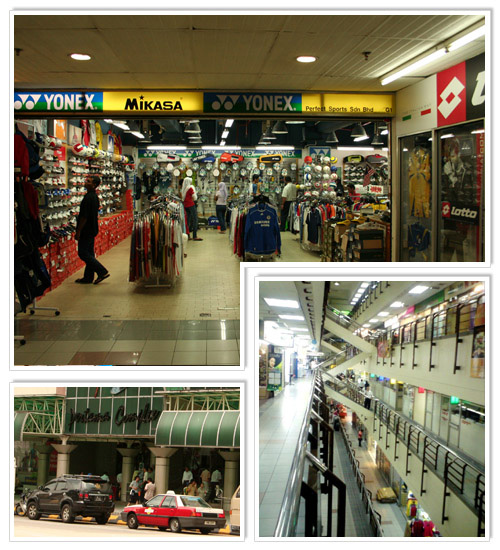
After that early episode, I decided to go cycling every Sunday (when there were no kenduris). From Damansara, I alternated going to Pertama Complex and Sungai Wang Plaza. Pertama Complex was the main hangout for schoolkids my age at the time – mainly going to Victoria Music Centre (or King’s one floor up) to make custom cassettes, as well as stopping by Joo Ngan’s bicyle shop (could only afford to look – the only thing I bought there was a chain tool). That and looking for Iron Maiden t-shirts there or at Campbell’s. At Sungai Wang I mainly went to the magic shop on the first floor, or just looking for interesting artifacts to be found within that cavernous mall. Riding in KL, I was the king of the road, whizzing between the traffic-snarled cars, occasionally kerb-jumping (on a racer, mind you!)
![]() |
| Sungai Wang Plaza |
![]() |
| Shops at Old Pertama Complex |
To be continued in Part II


,_Golden_Triangle,_Kuala_Lumpur.jpg)