Facing an Artistic Mid-Life Crisis Part I

Bookshops have always instilled a sense of wistfulness and adventure every time anyone steps into one. It is almost impossible to pass by a bookshop without stopping, if only to browse, to look, to linger. One could even sense one’s IQ almost increasing by just being there. I am sure my Fitbit Charge HR records increased palpitations wrapped around serenity in the vicinity of tomes.

Art shops are different. One can not help feeling a sense of creative surge, a sense of endless possibilities waiting to be unleashed. Pencils, pens and paintbrushes seem to wobble as soon as eager hands get within touching distance, almost as if one had entered Ollivander’s Wand Shop in Diagon Alley, where each art instrument aches and shivers in anticipation of being within its destined master’s possession. Discernment in the feel of the trade tools, and the weight and surface of the designated paper (not unlike thread-count of bed sheets) is personal. If bookshops made one feel more intellectual, art shops made one regard oneself as infinitely creative.

Although in the past few weeks all of the feelings above were sparked by a visit to Art Friend at the Curve, Mutiara Damansara, the origin of that ignition was an event that happened at St. John’s Primary (1) 40 years ago. Towards the end of every school year students were normally required to fill in a card, updating general information about themselves. There was a field, though, that was probably the most subjective thing anyone would ever ask you throughout your entire life, which more often than not morphs into different forms and elicit different answers, depending on the stage of one’s life. The field, or word, was ambition.

I was in Standard One after all, and therefore the pressure to be a doctor, lawyer or accountant did not suffocate my answer as yet, unlike an SPM-bound 17 year old hormone-maxed student. At 7, most would be guileless, where the imperative would be what one would get for one’s next birthday, or what’s showing on the telly later. The answer would even be expected to be inconsequential, as it would probably change if the same question were to be asked next week, not even next year. So with aplomb, and a total lack of commitment (or maybe even full, hard to tell right now), my seven year-old self answered what made sense at that time. The answer was two straightforward words: comic artist.

In the mid-seventies, comics in Malaysia were sold at newsagents and mamak grocery shops, often affixed to a suspended cotton or nylon rope with a wooden or stainless steel peg perched way above a 7-year old’s head. Sometimes it would get delivered to the home by the newspaper delivery guy, often wearing and off-centre motorcycle helmet aboard a kapchai, expertly throwing rubber-band-bound bundles of pre-ordered newspapers with unflinching accuracy into rain-safe nooks in close proximity to the front door. The world of Dandy and Beano, or the diminutive war or silat comics, were standard fare at the time. Occasionally, one would get a glimpse of a broadsheet Conan issue, and much later a 2000 AD, amidst SHOOT magazines and newspapers. What had really caught my fancy, though, and stayed as an effective bribe for me to go to the dentist, was American superhero comics.

The American superhero comics, mainly from DC and Marvel, were of approximately the same dimensions today as they were 40 years ago. The white box at the bottom left or right, which today indicates whether the comic was obtained from normal retail channels or specialty shops, was filled with bar codes as it was from the former. There were no dedicated comic shops at the time till maybe the late 80’s or early 90’s. The form felt comfortable to a 7 year old, or even a 47 year old today. X-Men, Superman, Aquaman and the Avengers ruled the roost. Hardcover Annuals were coveted and sometimes gleefully received as birthday presents.

Among the attractions of the American superhero comics was its temporal continuity, and one would await the next issue with bated breath only to be satisfied (and again tensely awaiting) a month or two later. They were also a tool for me to further learn English vocabulary; one particular episode of the Avengers, where the Vision was saved by another less-memorable character, I had learnt phrase “to be in one’s debt”, uttered by the former to the latter. Had to go to my father to get an explanation of that one, and the meaning stuck hard in my mind, especially when accompanied with the visual reinforcement.

But it was that reinforcement, wonderfully visual, that stayed with me the most. Whilst distinct panels contained the artwork, the panels did not stay uniform, contextually reforming like a storytelling ether-chameleon, where words and art danced to depict a story whose pace was half in control of the producer, and the other half by the reader. While the composition of views of bodies and surroundings uncovers the narrative(s), it was the inking and colouring that lent it emotion and motion, superiority and/or utmost insignificance. Jack Kirby and Neal Adams led the way for me, to be joined by later giants as John Romita Jr, Brian Bolland and the ambidextrous writer-artist combination of the brooding world of Frank Miller, the delightful yet scary world of Bone by Jeff Smith or the insane multi-media stylistics of Bill Sienkiwicz and later Dave McKean. These artists, and who had every right to be called Artists, made my world. At the time, for a time.

Fast forward 40 years. I am in my 10th job, having experienced various fairly diverse industries, yet none close to what my 7 year old self had opined. During a conversation with my second-born, when talking about ‘ambition when one grows up’ (have I even grown up?), he further quizzed me on why I have not fulfilled my ambition. When I thought about it, I then asked myself, why not indeed?

Part II deals with what comes next.

(This blog post, minus these bracketed words, is eerily 1000 words exactly, again.)

Face, empty space

Face, empty space

The Rubber Finally Hits the Road!

After a normally long hiatus, this post is where the rubber hits the road – I have finally bought my bike(s)! What was previously rhetorical sharing on what would be the ideal bike and my historical relationship with bikes, I have bought them, ridden them, am in process of upgrading them and therefore have lots to tell!

I did not want to start with an ideal bike. To a certain extent, I felt that I could not justify spending too much on my first two-wheeler, especially if the body has not worked up the fitness to deserve one. Countless hours spent shopping at various bicycle shops and reading profusely on forums and blogs resulted in one affirmation – it had to be either a Dahon or a Tern.


Why? My first experience with a folding bike needs some measure of assuredness – I needed to know what good looks like. I am not obtuse to riding less-branded bikes but first I needed to feel the finesse of a dedicated folding bike specialist. A low end one would do – and in this regard Dahons were generally more affordable than the Terns. In addition, having a respect for history and elders, I wanted to support the father first rather than the son.


One fine day, in one of my various stopovers at Rodalink Bangsar, I chanced upon some Dahons on sale. The one that caught my eye in particular was the Dahon Vybe, both available in steel and aluminium frames. I wanted a tough bike, and I have been known not to be too gentle with them, so I though steel would be the ideal choice, even more so as it was the cheaper of the two. WI thought the trade-off with it being heavier wouldn’t matter too much as I would mainly be lugging it from folding into the boot and vice versa, and not really lugging it around on trains and the like (splurging on a Brompton would be tempting on the latter point, but oh man the cost!). Moreover, I liked the white frame with black detailing of the Vybe C7 rather than the black frame with white detailing of the Vybe C7A. Saving approximately RM500 ringgit from its original price, I thought it was a rather good bargain too! And so the deed was done!


First Photo of the Vybe C7 at Putrajaya

I justified that the savings that I had made should be spent on accessories for the bike, and oh boy did I exceed those savings (by almost a factor of 2!) I started understanding women’s needs to accessorise immediately upon the purchase! I wanted the bike to be practical right from the start and therefore the first concerns was how I would carry stuff. I loved the solid look and feel of Tern’s Cargo Rack, which looked much tougher than their Portage Rack, both from Biologic. I do have dreams of attaching panniers to them one day, and the Cargo Rack seemed like a good move to future-proofing the investment.

 Secondly, tools were required for maintenance. I chose Topeak’s Aero Wedge Pack that would fit under the seat. In in I out Topeak’s Racerocket MT Pump which fits just nicely, as well as a Schwalbe 20″ spare tube. For comfort, I affixed a Selle Royale gel-padded seat for my rather ample posterior.On a separate visit to Rodalink, I quickly added the Tern Luggage Truss with a Biologic Tour Bag which was on 20% discount. The Tour Bag is a real jack-of-all-trades for me, easily fitting many things including water bottles when required. It unhooks easily yet is sturdy when clamped to the Luggage Truss (mine is in black). There is also a key lock at the luggage truss that avoids the Tour bag being taken away, although this should only be used for short periods. For longer periods, the Tour Bag can be attached to a shoulder strap and carried away. It also has an internal waterproof lining that avoids getting your things wet.

I then thought I needed an even bigger bag, and having the Cargo Rack, the recommended bag was Biologic’s Commuter Bag, which can clamp onto the Cargo Rack easily using the KLICKfix bracket system. It also has a 3Point shoulder strap converts into additional straps onto the rack to stabilise heavier loads, especially as it sits on the Cargo Rack vertically. 

I have tested the bag at my maiden trip going from my house to Bangsar Village to get dinner (lots of stops due to really tough hills). Went to Basil to get takeaways for 5, and it fit nicely into the Commuter Bag. I should, however, put them in a plastic bag before putting in the Commuter Bag as some gravy actually spilt when in the bag. The some of the padding can be detached (velcro) for cleaning. Some of the spilling could have been due to some rather fast rides over the speed bumps and ‘kona baring’!
 
 
Waiting for the food at Basil with Commuter bag and Kabuto
To complete the accessories, I bought a white OGK Kabuto SP3 Extreme Sports Helemet which seemed to provide the best padding as I thought the typical Road Bike helmet seemed somewhat flimsy.Thus is the first stage of using the Dahon Vybe C7 and completing it with accessories. From Bangsar, I have been going for occasional 6km bike rides around the Bangsar and Kiara. Subsequently I had started riding around the UNITAR area in Kelana Jaya with a typical route of approximately 7km.
 
Next up – I did get an ideal bike!

Treading the Path of the Heifer’s Gaze, this Ramadhan

“Will they not then earnestly seek to understand the Quran, or are there locks upon their hearts?”

Surah Muhammad, 47:24

“It is ironic indeed that the Quran that places so much emphasis on pondering and serious study of its contents in order to gain any real benefit, is also perhaps the only book that is read without any serious thought or attention to its message or substance. Ordinarily, when studying a book, most people would first prepare themselves mentally. In the case of the Quran they usually close their minds the moment they open it up to read”

Introduction, “Pondering over the Quran”, Amin Ahsan Islahi

So yet another Ramadhan approaches, and I echo the thanks of many Muslims that we are alive to greet another of the blessed month. The zeal with which many greet this time of the Islamic calendar year is often great, but undoubtedly for many this does not quite last. Once work and family pressures pile, it is all to easy to slip back into the normal routine, albeit with different meal times.

I am not here to offer a formula to avoid the aforementioned. One only needs to peruse one’s Facebook and subscribed Youtube channels to access countless pieces of advice by the Masyaikhs and friends (usually reposts of the Masyaikhs) alike, much of which are of great use if followed. I can almost hear the countless covers of the Quran being opened (um, just dust it off first, ok?) and pages turned, so many eager to finally finish a full reading by month end. My personal efforts throughout my life have been rather mixed, more often than not significantly short of initial targets. Being a realist, then why not set lower targets, I thought to myself. Why not indeed.

A few days ago, I had updated my Facebook status, which reads “Salam all, hope you all have a wonderful and reflective month of Ramadhan – Rediscover your purpose. Realign your compass. Refresh your target of the ultimate destination. May your journey be blessed and fruitful. Ramadhan Mubarak”. Reflect, rediscover, realign, refresh – not too shabby as goals. Now how could I achieve all that while making it achievable? The answer that came to me is to look in the direction of Bovines. Really.

The link between the month of Ramadhan and the Quran is unmistakable. The Prophet Muhammad (peace be upon him) was visited by the angel Jibreel on the 17th night of Ramadhan, upon which he received the first ever Revelation in the form of the first five verses of Surah Al-Alaq (The Clot 96:1-5). However, the Quran we have today was not arranged in chronological order;  the Prophet (peace be upon him) arranged the verses as they were revealed through divine guidance. The closest I have come to comprehending the order was covered by my earlier post here.

In that post, it was the approach of the main text that was discussed, Amin Ahsan Islahi’s “Tadabbur-e-Quran” (Pondering over the Quran), that in order to understand the nazm of ‘coherence’ of the Quran, the author had attempted to address the longest Surah in the Quran first and foremost, as it represents the most complex structure of all surahs. This is of course Surah Al-Baqarah (The Heifer, thus my bovine referral), the second surah in the Quran which contains 286 ayat. As today is the third day of Ramadhan, those of you who target to complete the full recitation of the Quran would most probably have completed this surah already, and have moved on to others. My target this year is to read and appreciate the overall meaning of this surah, inshaaAllah.

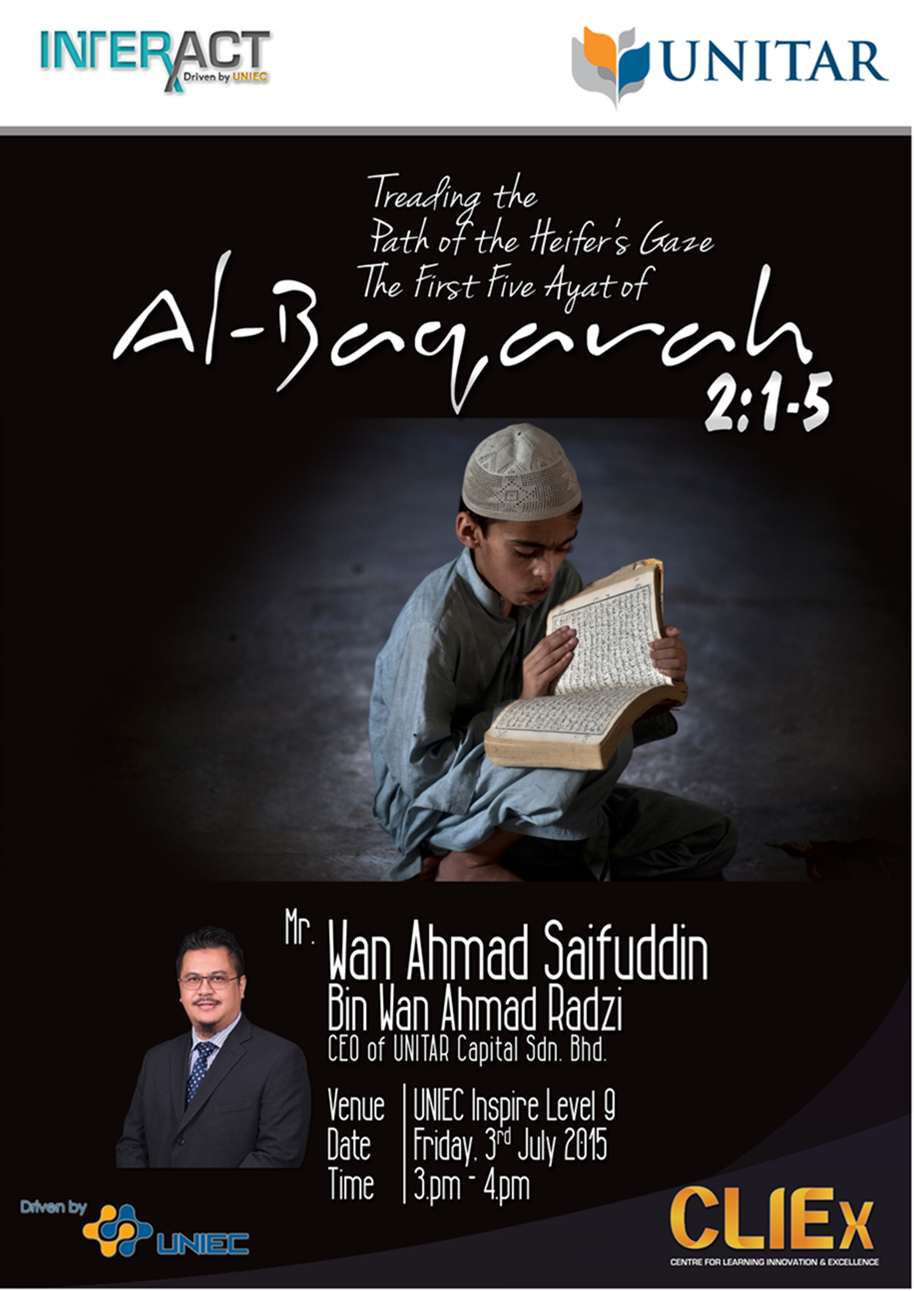
For those who are interested, I will be giving a talk entitled “Treading the Path of the Heifer’s Gaze: The first Five Ayat of Surah Al-Baqarah” in two week’s time at 3-4pm on 3rd July at UNIEC Inspire, Level 9, UNITAR Kelana Jaya Campus.

heifer

THE ACCIDENTAL EDUCATOR: The Making of an Educational Transformer

I had not planned to be an educator. Sure, Mak had been a teacher all her life, and Bapak’s first job, albeit for 2 weeks, was as a teacher too. One who educates, me? The architect way back in 1997 only had his job and his betrothed as his world, with nary even a fluttering thought of a didactic persuasion.

Handling 13 concurrently running on-the-ground projects was no walk in the park. The then-heady early to mid-nineties had caused a proliferation of projects, spawning offshoots faster than a rabbit on the blue pill. Doing a project meeting almost every other day, and starting design work only after 6.30pm when the phone calls died down finally took a toll on this normally rather resilient self. A request to the then-bro-in-law cum boss resulted in acquiesence to a simple proposal: 2 half days a week off with a prorated pay cut, so that I could teach. Mindset switch / constructive distraction needed, I argued – yet I will retain the same workload. Brain needed to function via external stimuli.

I had heard of an opening for lecturing at LimKokWing School of Architecture. After all, Corbusier, Mies van der Rohe, the greats – they all taught, so why not me? Not that I considered myself anywhere near the icons of the built environment – it just sounded like a sexy thing to do, intellectually. Heck, I could finally dust off the reams of notes of Colin St. John Wilson, dive back into the vernacular leanings of Aalto and Scharing, even throw in some Heidegger to boot! Sounds like a fun frolic of intellectual … err, exercise.

Joining a group of 6 lecturers teaching Architectural Theory to a class of over 300 students was excrutiatingly daunting, till one observed that there was a cunning system at play. A subject was picked and expanded by a selected SME, and one-by-one the other lecturers gave their 5 cents, creating the rather substantialised chain of opinions on the subject for the group of sensory-enthused learners. Design studio proved more of a challenge, as personalised tutorials for project development was the order of the day, but up the to challenge was I. It was like… a calling.

The ’97 financial crisis put paid to my architectural ambitions as projects stuttered and stalled. Having educational neurons tingled, I dived headlong into becoming a full-time contract lecturer (with 32-hour teaching load as a norm), taking on teaching Infini-D 3D software and Web Design and HTML Programming to Electronic Design and Multimedia (EDM) pioneer batch at LimKokWing. There was even time to teach 3D to Product Design students, as well as Web Design in the Business School, where the latter resulted in my most current claim-to-fame: having taught and tutored Maya Karin on web design using the now-defunct Claris HomePage application, though only for about 3 weeks as a temporary lecturer – but hey, who’s complaining!

It was with a fellow lecturer, the effervescent David Chan, (and later to be joined by the cool-headed Chung Tack Soon) that I co-founded and nurtured a dot com through highs (RM5 mil investment from New Zealand) and lows (the dot com bubble burst the company after 4 years). Taking refuge as a Design lecturer for Alpha students at MultiMedia University (MMU) in Cyberjaya, I had also embarked on starting a PhD; that was, until Petronas’ fledgling management and IT consulting company beckoned me with none other than eLearning, a project which combined my Internet technology background (derived during my dot com days) with education. They paid three times too as much so I was off in a jiffy!

Four years in the electronic education space was followed by a short stint with a start-up venture capitalist, with my most tangible contribution being setting up Tun’s bakery (and production kitchen) in Langkawi with an ex-colleague. It was not the skills in procurement of pastry and bread-making equipment that landed my next position in the national strategic investment company, but rather (or so I would like to think) the rather quirky journey of educator and educational instituion establisher that led my to actualising the Malaysian Directors Academy, or MINDA within the GLC Transformation Programme. Instructional Design knowledge and the various setting up of business garnered during the e1000 and iPerintis days greatly assisted the journey of MINDA’s conception, together with my minuscule yet able team.

What followed, whilst still serving in Khazanah, was a barrage of other educational expeditions: while MINDA was targeted to Enhance Board Effectiveness (and thus teaching mainly rather aged gentlemen, with the occasional presence of the fairer gender board member, which is just about as downstream as you can get, save for the talqin-readers), setting up the Trust School Programme went further upstream pioneering true Public-Private Partnership in enhancing educational outcomes for adopted schools, whilst giving some rather bare assistance to the two founding young ‘uns who started “Teach for Malaysia”. A spattering of other education-related projects included a feasibility study for the Ministry of Finance on the setting-up of an ASEAN Business School (I had recommended maximising current resources, concurred by the ebullient Dr. Nung), exploring potentials of MMU and UNITEN, both being investments by Khazanah-related GLCs, as well as contributing to the setting up of a Business-Approach turned Institute (Fahmy, you were part of this exercise, unbeknownst to both of us at the time, albeit on opposite sides).

Fifteen years after my first educational foray, a Malaysian Governmental Private Equity firm beckoned. The objective was to look at a potential PPP in Teacher’s Training. After not quite taking flight, the focus shifted to managing current investments and acquiring additional higher education institutions, which paved my way to UNITAR. Slightly after the middle of next month, it would have been three years for me at the Leading Innovative Social Science University.

Looking back, the colourful meandering path that had been taken was almost a cumulative education preparatory journey in itself. The Rearchitecting Journey of UNITAR has been ongoing for the past 3 years, although by no means complete. Mayhap this little piece gives you a glimpse of the journey of this Accidental Educator.

(This post had appeared earlier on the author’s Facebook Notes, though rather substantially edited and added. A little piece of trivia – this post, minus this last bracketed comment, counts exactly 1000 words.)

IMG_20141127_092836

All I Want for Jumaah is…

Peace!

Today I went for my first Solat Jumaat (Friday Prayers) at Masjid Bulat (officially known as Masjid Tun Abdul Aziz) in Section 14, Petaling Jaya for quite a while. If you ask me to recall what it was about…. ummm, well, the khatib mentioned about characteristics that are desirable in a Muslim, sifat mahmudah, and ummm… yup, that’s the limit of my recall. I did not sleep, mind you, unlike many others around me. But I did not leave the mosque feeling enriched by the sermon.

Yet the khutbah (Friday Sermon) is such a wonderful opportunity to touch so many lives. Many, if not most male Muslims make an effort to attend, and for those who are concerned, one who enters the mosque early gets the most rewards as recorded by the Angels that stand at every door of the mosque until the Imam sits on the pulpit (Sahih Muslim, Book 4, Number 1864). According to Ibn Kathir’s Interpretation of Sural Al-Jumaah, one is prohibited from participating in buying and selling after the first Azan – you can often see in Makkah that all traders shut down prior or upon hearing the Azan. Yes, stop eating dude, the khutbah is starting already!

For the last couple of years, the mosques in Malaysia have started using Powerpoint slides during the khutbah. I have long been an advocate of this – I had thought that a visual presentation would surely be able to combat the sitting slumber that happens during the khatib’s speech. Moreover, many Friday mosques have air-conditioning which adds much comfort for the attendees who otherwise had to contend with the high humidity. Alas, in general, the Sandman’s actions seems even more prevalent and even potentially aided further by the cooler environment. Things do not seem to be improving. So for what it’s worth, I am putting down a wishlist for the weekly Friday khutbah, with the hope that it leads to a much higher level of spiritual efficacy. It is divided into two sections; a wishlist for the attendees, and a another for the khatib and mosque committee.

For Muslims going to Solat Jumaah at the Masjid:

  1. Friday is an Amazing Day, beyond TGIF (and even in TGIF God is mentioned – if only you were serious about thanking God when you said that). The eight hadeeth before the one mentioned above in Sahih Muslim, Abu Hurairah had reported Allah’s Messenger (peace be upon him) as saying: “The best day on which the sun has risen is Friday; on it Adam was created, on it he was made to enter Paradise, on it he was expelled from it.” OK maybe the last point wasn’t so positive, but certainly a historic day. Celebrate Friday not just for the weekend that comes after, but for its spiritual significance.
  2. It’s Dress Up Friday, Dude – it is somewhat remarkable that people dress up to go on an occasion (a party, graduation, official event) but dress down on the Day of Celebration. I have nothing against going casual on the last working day of the week, but when you’re Muslim it shows your state of mind. Your dressing on the day is but a reflection of your God-consciousness, as many hadeeth encourages Muslims to wear their best clothes, put on perfume, and white clothing is encouraged. Personally, I like wearing jubah or thoub on Fridays as it helps me focus on its significance.
  3. Listen, Don’t Sleep – It’s hard. I know. It helps if you don’t have that Lamb Briyani before Solat Jumaah though. Maybe not today, but during many khutbah I have been able to extract learning gems. One that sticks to my mind is a khutbah at the former ISTAQ building at Jalan Damansara some moons ago, where the khatib used the analogy of luggage, immigration and travelling to ask the listeners to know what provisions they are bringing to the hereafter, and what the Angels would be looking for as one goes through the spiritual customs check. Your luggage would determine your destination. And oh, it was in English.
  4. Seek to Understand – every Jumaah, maybe target to know a little more of what is being said. For example, the khatib usually starts (and often repeats) with Surah Al-Ahzab 33:56 – you know the one – “Innallahu wamalaikatahi yusollu anannabi…”; “Allah and His Angels send blessings on the Prophet; Oh you who believe! Send your blessings on him and salute him, with all respect”. Now that you understand the meaning, the khutbah would be more interactive and you would give your salams to the Prophet (peace be upon him) right after hearing that verse. Everytime. Every Jumaah, you would learn to know a little bit more about what you read in Solat – and you would get into prayer, not just saying the words and acting the acts.
  5. Let the State of Solat Linger a Little Longer – Paucity allows for lasting reflection. Do not quickly get up after the second salaam, but just sit there. Enjoin in the du’a, inhale its meaning. Be still. Let the others get up and rush back to the office or restaurant. Breathe in, out, slowly. You had just finished a conversation with your Creator. If you were not moved, you did not really converse – you blabbed, and the result was accelerated evanescence. Poof, and the masjid is just a blur behind you. No. Make it count. Let it linger, and assimilate with your spiritual flesh. Just Be. With. Him.

Then there are things that the khatib and Mosque Administrations could do:

  1. Make the Masjid a Community Centre – many mosques in the West even have sports facilities – how else would you attract the youth the treat it like a destination? Activities there should not be limited to the religious events, but also ‘normal’ events that brings a community together. It should be kid-friendly (oh so many aren’t – however Masjid Besi in Putrajaya especially during last Ramadhan was a shining beacon in this respect). Also have or retain a proper place for women and facilitate making it easy frontmen to pray Jumaah like in Makkah – over here, during Jumaah the women’s section is more often than not commandeered for the men! Only then would offering Solat Jumaat seem more than a ritualistic exercise – give people more reason to be there, and love being there.
  2. Make World Issues Mosque Issues too – the poster below is a great effort by Masjid Bulat to conserve water, where so much wastage occurs during wudhu (ablutions). My father had suggested to some masjid before to even recycle the wudhu water to be used for watering the plants within the mosque compounds; sadly, the suggestion was not taken up – such wasted opportunity to demonstrate Muslims’ attitude to this Earth. In addition, the khutbah should also be directed to real-world problems that affect the community. As mentioned by my friend Reza Ali earlier on FB, why doesn’t the khatib emphasise the lowering of the gaze of men, rather than just asking women to cover their aurat. Economics, Green Living, Respect for All, Care of Animals, Being good to Fellow Man should all be topics for khutbah.
  3. Choose Polymath Imams – Islamic Scholars of yonder used to be multi-disciplinary men of learning who were as comfortable to converse about philosophy and sociology as they were hadeeth and Quranic interpretations. Encourage and sponsor bright students to study Theology and Islamic Sciences, whilst developing their more ‘secular’ knowledge so that they can make and give informed religious opinions. I would place Ustaz Hasrizal of saifulislam.com in such a category – and he has a wonderful writing and presentation style in both Malay and English
  4. Enhance Visual Storytelling – the Powerpoint slides that are shown should not be a mere teleprompter for the khatib and reading fodder for the makmum; the masjid should have graphic designers turn the text into visual storytelling experiences that enhance the message to be conveyed, as well as using storytelling techniques (pacing, storyline, significant and memorable punchline and takeaways so that the khutbah then transcends the masjid’s space and time). I believe it is worthwhile to invest in more screens that could be temporary for the Jumaah Prayers installed – think of the creativity of Mamak Restaurants.
  5. Engage the Community, Address Concerns – know and understand what the surrounding community requires, and address them. Work with them, regardless of race and creed, social standing, language etc. A mosque helps ALL. And talks about these issues and galvanise the community to address them in the khutbah. Now, that would be impactful, meaningful. And the mosque would really matter once again.
jimat air

Save Water

masjid bulat internal

Inside Masjid Bulat after Maghrib

Quick test ride of Moulton TSR-9

Brought my sister and her husband to Van’s Urban Bicycle Co. at Kampung Tunku last Wednesday and had the opportunity to test ride the Brompton 6-speed, Tyrell FX and the Moulton TSR9. The Brompton had a leisurely feel, the Tyrell was like an impatient racing feel – it just wanted to jump off the blocks and speed! The Moulton, I must say, was a class of its own, as the rider and bike became one, inseparable. The dual suspension made a difference, but the frame balance between rigidity, response and fit was unparalleled. I now dig what Moulton buyers feel. One day…

My Ideal Bike

After so many months of desktop research, sporadic visits to bicycle shops and reading as much as I could, it was time to first decide what would be the ideal bike for me. I had a couple of particular criteria that would really narrow down my choices:

  1. The bike would have to be foldable due to:
    • convenience – can put in the boot and ride whenever I felt like it, and without needing a bike rack
    • coolness – I just simply buy in into the whole folding bike genre philosophy, and do not see myself as a MAMIL (Middle-Aged Men In Lycra), a phenomenon especially prominent with Road Bikers
    • posture – foldies are usually require an upright stance, which is compatible with more leisurely pursuits, and I intend to mainly cycle alone
  2. It would ideally be able to do some off-road:
    • I fancy the idea of being a prepper, and in emergencies one could just get the bike out and go to just about any terrain
    • to be able to do off-road, it would need to have either a front-fork suspension or full suspension
    • Off-road would also require a pretty good range of gears, more akin to an MTB than a Road Bike, but most ideal would be a hybrid between them
  3. From most of my readings, if the bike were to be foldable and have off-road capabilities, then one would have to go to established folding bike brands:
    • Pure folding bike companies would be preferred, as their total design concept would be to have the ideal fold and therefore the quality of the components involving the fold and more importantly the frame design should be much higher
    • Quality Dual Suspension would be preferred, firstly to withstand the state of Malaysian roads which may be a good training ground for off-road adventures!
    • Quality components would be required to handle both road cycling and light to heavy off-road use
Having painted myself into such a tight corner with such difficult requirements, there were only 3 bikes that would come close to meeting my expectations:


Often touted as the Rolls Royce of full-suspension foldable bikes with off-road possibilities, the Dahon Jetstream EX 2011 model would be the ideal bike for me. Dahon is arguably the highest seller of folding bikes in the world, and certainly one of the oldest and most established. The Jetstream EX has a German A GA Force Kilo A Air Shock front suspension with a Suntour Epicon Air with lockout and damping adjustment, with SRAM Dualdrive II 27-speed hub with SRAM X9 Rear Derailleur. I must say I was greatly influenced by Sam Cheong’s Samosaurus Chronicles coverage of the Jetstream EX and his wife’s Jetstream P8. It was also through his blog that I read about Debby & Carrey’s off-road pursuits which included pushing the Jetstream EX to extremes until it failed!


German A GA Force Kilo A Air Shock

Folded


Unfortunately this bike is no longer on the market. According to Samo there were only 10 units that were brought into Malaysia. The original price was also close to RM10k if I am not mistaken, with a second-hand unit that was going for RM4.8k on bicyclebuysell.com though no longer available. I was also tempted after finding it online on an indonesian website with an encouraging price of USD1.4k but do not have the budget at the moment. If anyone does purchase through this website please tell me!


2. Airnimal Rhino Black ‘Wild Thing’


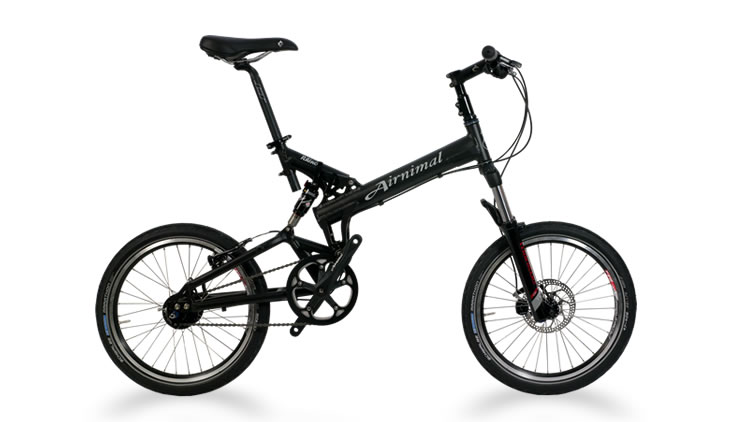
While the Dahon Jetstream EX has been marketed as a trail bike, the Airnimal Rhino is a full-on off-road full suspension foldable ensemble. With Manitou Marvel 80mm front fork suspension and a Rock Shox Monarch rear suspension supporting a hovering frame design, the Rhino Black seems to be an equal (to the Jetstream EX) if not more ideal bike for me. Its Rohloff Speedhub 14-speed 32h Rear Sealed Gear Hub has a gear range of 19 – 101 inches.


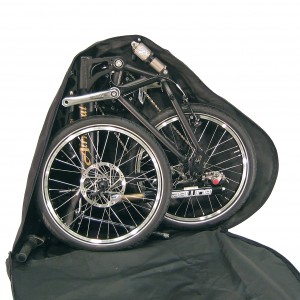
In addition, it has two fold options as well as cases that corresponding to them. In addition, the frames can take one config of 20″ and two configs of 24″, its geometry designed to have the handling of a standard road bike, as well as a fold design along its centre line to provide stiffness. I have not actually experienced an Airnimal, the closest being my visit to My Bike Shop (MBS) in Singapore a couple of months ago when they showed me an Airnimal Joey frame and its vertical fold.


First Fold


The Airnimal Rhino actually comes in three configurations – the White which is a lower-spec off-road config using an 8 speed Alfine hub and Airnimal 48T Crank weighing 14kg (UKP1899), the Black using the 14-speed Rohloff (as above) with Airnimal 52T Crank weighing 13.6kg (UKP3299) and the Road with a 27-speed Shimano Tiagra-Ultegra-Deore drivetrain with FSA Gossamaer Triple-crank and Pro LT Dropbar combination weighing in at 11.5kg (UKP2199). So price-wise, even more out of reach for me – takes a special kinda bonus for me to splurge on this beauty.


3. Montague Paratrooper Pro


Montague is the only company I found that only makes full-sized foldable bikes. Its Folding Integrated Technology (FIT) was reputedly funded by DARPA for designing a bike that can be transported by a paratrooper (hence its name?). Montague focuses on two lines of bikes, the Pavement Bikes (FIT, Boston 8 and Boston), the Multi-Use Bikes (Navigator, Crosstown and Swissbike X50) and the Mountain Bikes (Swissbike X70 and X90, Paratrooper and Paratrooper Pro). The Swissbike and Paratrooper models all use the same frame, and I have a preference for the matt-black finish of the Paratrooper Pro (notice that all of my 3 choices above are black or dark framesets!)


The Fold


Between the Jetstream EX, Rhino Black and Paratrooper Pro, it seems that the Paratrooper Pro could probably take the most off-road punishment, having the geometry of a classic Mountain Bike and having a standard MTB Front Fork suspension (and therefore having many options and easier-to-find replacement). Unlike Jetstream EX and Rhino Black though, it is more of a hardtail frame design and is therefore not a full suspension bike. It does seems to feel like the most durable though – I had seen one at Van’s Urban Bicycle Co. shop at Kampung Tunku, PJ and man, it feels amazing. With the price just north of RM4k, it is the most affordable among the three choices.


Thus I have presented my ideal bike choices. Like life though, one often does not start with ideals. My next post will outline my first 3 bike purchases and why (here’s a hint – it’s none of the above!). Stay tuned for the next installment, which hopefully will not take a month like the time between this post and the previous one.


25 Revisited

In 2009 there was this thing on Facebook where you’re supposed to post 25 things about yourself, and tag 25 more friends. I hardly participate in any of these but I thought, why not? This was written in 2009, and might be a good way to (re)introduce myself, albeit with some updates:

1. There are 33 letters in my full name, and that excludes spaces (but includes ‘bin’). Filling in forms was a nightmare, where more often than not I had to add boxes. Can’t imagine the additional energy my parents used to register me. It was my uncle who named me, to whom, really, I am eternally grateful for giving me a good name. Oh, and in exams, I was almost always the last 5 people to receive papers (and that much less reading time! Explains my marks somewhat…). Anyone who sits at the back of the class in exams please give me a holler, yo.

2. Arabs tend to react with a gasp to my main name, ‘Sai-fud-deen’. Being known as the ‘Sword of Faith’ (had made me reflect often. Even found a book whose title was my name whilst doing my thesis – the treatise of Islamic symbolism of water (by Nasr and Burckhardt) was a particularly diaphanous moment – and hence this blog is entitled “Sword of Gnosis”.

3. I am colour-blind. And no, I am not amused by the next reaction by most, which is ‘Hey, tell me, what colour is this?’ That’s like telling someone who had just been amputated knee-up to attempt a moon walk. That said, when people don’t know, they usually come to me for colour advise and walk away somewhat satisfied. My heart goes out to my gene-passers, who are/were also fellow sufferers, Mak, and her dad, arwah Tok Man, who managed to be an MP and doctor. So there.

4. By now you’re probably thinking ‘Oh God! Why can’t he just do a simple LIST!’ I do appreciate simplicity, as it is often a result of a palimpsest of attempts to get it right. Try designing something simple that works, and you’ll find producing something complex that does not quite work is a lot easier. This is especially true when I was teaching at the architectural studio in university, something which I may be resuming soon.

5. I have approximately 163 first cousins. To my knowledge only other Malaysians and Africans have topped me so far. Dropped the jaws of my Irish friends, who had on average about 3. I think I know most of them, though I live by the fear of accidentally running one over every time I drive. Remember the Agent Smiths in Matrix 3? I see cousins that way.

6. My great grandfather (from my father’s side) walked from Kota Bharu to Kuala Kangsar, and apparently married 4 along the way, which could go some way to explain that I am related to almost everybody I meet. He did become the first Mufti of Perak, although his great grandson has some ways to go. Same guru with Tok Kenali, and apparently about 9-levels removed from the founder of the Naqshbandi, as a researcher once pointed out. Me, I’m just still trying to figure out the stuff I recite during solat. Like I said, some ways to go.

7. I drank a glass of kerosene once, somehow mistaking it for water. Does not say a lot for my olfactory system. Must have been about 5, and was living with grandparents at Batu 8 1/2, Labu. They had to pump it out, but that part I remember not. Must have passed out.

8. I remember living in Labu vividly, where my moyang often had to ask us to raise our feet when sitting at the rattan chairs. To get them out of the way of the snakes passing by. Somewhat of a highway for the serpents, that house. Also witnessed my late maternal grandfather shoot a cobra as it was poised to strike. Nerves of steel, he had. I also remember the ‘beca’ rides, sending my sisters to school. I was not in school yet, and was reportedly prone to running naked around the mangosteen tree to avoid having to wear clothes. Fortunately, I grew out of that phase. I think.

9. Another serpentine moment was in Telok Anson, where we had those hollow-brick walls. Was wondering how a pile of cow-dung (that surprisingly did not emit its odour) got into the living room. Some poking resulted in a cobra’s head hissing back. Jumped onto the table in a single pounce (would have been an Olympic record as I was 4). And this was probably my earliest lucid memory – oh, that and being fed ice-cream by my sister at Kampar.

10. The geographics of my earlier escapades above obscure the fact that I am really a born and bred KL-ian. Came into this world at GHKL (now shortened to HKL), clocking in at 7 3/4 lbs  at approximately 2.00am and was back in KL when I attended Calvary Church Kindergarten. True-bred Johannian from School 1 to SJI (only Fatima Kindergarten attendees and Form-Sixers outrank me!)

11. My wife and I and our three kids used to sleep in the same room. We had 2 queen-sized beds put together with a large single bed. It is not unusual for one to traverse 2 beds in slumber. It is also not unusual for me to find one of my kid’s butt on my face when I wake up. Wouldn’t have had it any other way. Now they all have their own rooms, and one is already doing Foundation in University. All my kids somehow still like our bed and often slump at the edge when my wife and I are there. Old habits, I guess.

12. I used to sleep on an unrolled cotton mattress (tilam kekabu), usually made in Kuala Kangsar by my grand-auntie, who has since passed in her 90’s. Finally got my own space at 16 (there was a curtain put up to demarcate the tv room and the corridor leading to other rooms, making my ‘room’). Finally got my own room at 17. Before that I was a nomad in other rooms.

13. I am usually shipped to Kuala Kangsar or Pantai Remis during school holidays, more often than not by third-class mail train. If it were closer to any festive season, I would normally end up in the cargo section, sitting or lying on the floor. This was probably where I learnt my ‘sleep anywhere, anytime’ skills. Also, memories of putu packed for the journey back to KL, usually lovingly wrapped in my handkerchief by my amazing Opah (Perakkian for grandmother), and I have a craving for it sometimes. Hard to find nowadays.

14. I loved Enniskillen, and I think it loved me back. My first real overseas trip was a brief stop at London before landing in a little town between Belfast and Dublin. I shared a room in lower 6 with my third-cousin from Kelantan, and got a humongous room when I was a prefect in upper sixth. I made some money recording songs from LPs to cassette for other boarders. I headed the photography society, restarted the table-tennis club in a defunct shooting range and even played basketball, table tennis and football for the school. I sucked at rugby, was just not fit enough. Just wished I took up sailing, rather then getting lost in the forests during orienteering (more often because I wanted to take photos rather than race, and the teachers often had to look for me and my cousin, often much to their chagrin).

15. The defining experience at St. John’s Institution was becoming a Councillor Prefect or CP. We first had to be voted in, then pass written tests, undergo a 3-month probation, and finally screening with teachers rep and the prefects. There was an interesting degree of autonomy from the teachers as we were to represent both students and the school. The team-building and training was among the best I have gone through in my life. The imperative word for our behaviour was discretion, something I feel many in the course of their life still fail to grasp.

16. I rediscovered Islam at Enniskillen. I really started learning again at Cambridge and Edinburgh, and I remain very much a student to this day. Before that was really the normal rote-learning at school and some additional classes, but they did form a basis on mainly what to do, but not why to do it. Tawheed was taught but not understood, nor really appreciated.

17. I am quite a Nasi Lemak person. My favourite, due to time (usually before family and I go for our little excursions) and even somewhat ambiance (more to do with the crowd I think) is Nasi Lemak Tanglin near Lake Gardens, followed closely by Nasi Lemak Cikgu at SS6 Kelana Jaya (love the Ayam Goreng, Sambal and Sambal Sotong – although ambiance-wise it was way better as a stall). A consistent third is Le Cucur KLCC Nasi Lemak bungkus. Not quite a connoisseur but I like consistency. Lately Village Park Nasi Lemak has been topping the list.

18. I am still searching for the perfect lontong. Top of my list is Che Nor stall above the Section 14 PJ market one (the old Medan Selera), follwed by a rather obscure stall at the back of the Datuk Keramat market. A Kelantanese corner shop at SS5 used to be good, have not tried it lately. There’s a fancy one in Kampung Baru which seems very popular but a little too hodge-podge for me.

19. I am not quite an internet child (although I can be rather child-like), but have been online consistently since 1995. Used Mosaic 1.0, and clearly remember the PPP redialling and waiting for the connection tone for hardware handshaking, and even bought a version of Netscape Navigator to support the revolution! Was addicted to Webchat where I made many friends, at least 5 of whom I’ve met, and two who got married (but sadly divorced now) actually came to my wedding. Did not like the pace of IRC but loved newsgroups, where I quickly learnt HTML Programming. I was one of the first 8000 users for Jaring, and a beta-tester for TMNet. Even started a dotcom company, which was an amazing experience. I have a rather long failure resume.

20. I am a kind of Islamic Fundamentalist, not an extremist. I believe one should go back to basics, back to the sources, to discover/rediscover what one’s religion is all about. I have much greater respect for those who subscribe, believe in and practice the transcendental, who can then be at ease with the secular. I believe secularism as the root cause for all disorder and injustice. The Enlightenment is a misnomer, in my mind. Religion is a way of life, though many use it to their own perverse end. In the end, from Him we came, and to Him we return. God knows best.

21. I have no ambition in my working life. All I wish is to help, and be of good use. I do believe in the notion of stewardship and trust. Without it I believe one does things aimlessly, even though one may be fooled into having meaning in one’s life, where the meaning may change as one’s outlook changes. I feel rather like Scott Bakula’s character in Quantum Leap, sent by the unfathomable into a next mission. Often when I look for jobs, it doesn’t happen. It works only when the jobs look for me. And at the transition, like Quantum Leap’s Dr. Sam Beckett, I too say “Oh boy!” Incidentally, I went to the same school as the real Samuel Beckett, Portora Royal School (at least for my sixth form).

22. I am often perplexed by people who live contradictory lives purposely. At the same time, I have no idea what they go through in their lives and should just give everyone the benefit of the doubt. I myself am far, far from perfect. But sometimes you see things that do not make sense. I addresses it by starting with the question, “Who benefits?” Then, potentially, the truth emerges. But I continuously ask for Divine Guidance.

23. I love buying books, but only recently started to seriously read them. I write so that I can remember what I just learnt, read or discussed – it otherwise vanishes to the nether regions. I am often guilty of Tsundoku, and there seems to be no cure. The piles are getting bigger. Hopefully understanding what I read is getting better. Just bought a wonderful book called “How to Read a Book” by Mortimer J. Adler and Charles van Doren. Wish I found it sooner.

24. I sometimes go into ‘Mentat Mode’ when needing to think (in reference to Frank Herbert’s “Dune”). A more thorough reading of the Quran has given me spiritual highs not thought possible before – but only with the permission and grace of the Creator. Was very, very happy to have discovered Amin Ahsan Islahi’s “Tadabbur-i-Quran”, which is really helping me along the journey. In the end, one starts with oneself. I am nothing, only then can I be.

25. You’re still here? Salute – your attention span is remarkable! Peace.
glass

Hitting the Books

Being somewhat of a nerd, I always read around a subject before attempting it. My re-introduction to cycling was no different. Taking a break from my desktop-warrior research into folding bikes and the world of Dahons, Terns and Montagues, I poked around Amazon to see what I could read on my Kindle (see, nerd).


I was first looking for something that would make me get up an go. Being committed to an urban-riding philosophy, I did not want to become another semi-fitting lycra-wrapped overweight cyclist with the latest Oakley on his nose-bridge. I wanted to ride in normal clothing, wearing normal shoes or even slippers, much like I used to in my teenage days. Neither am I Messenger-bag toting London or New York-ish rider whizzing through the streets with purpose. I just wanted to take my time riding, and preferably alone most of the time, hearing the wind in my ears, before being engulfed by my heaving and shortness-of-breath sounds that would likely happen very soon afterwards.


It was refreshing then to discover Grant Petersen’s book so aptly-titled “Just Ride“. The reviews from Amazon made it clear that it was for “the rest of us” cyclists, me most possibly included. It has been compared to Michael Pollan’s foodie books, and it is perfectly what I was looking for. Full of practical advice easily understood by noobs like me, Petersen’s writing style is also honest and hard-hitting where it needs be. After reading this, and finally getting the right price, I went out and bought my Dahon C7S from Rodalink Bangsar and did that – Just Ride!


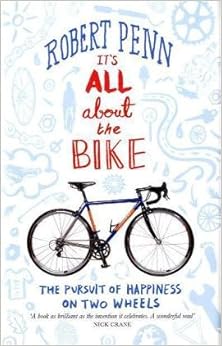
My beloved wife then bought me another Kindle-download – and this was a very different book. Robert Penn’s “It’s All About the Bike” title is a play on Lance Armstrong’s “It’s Not About the Bike” book. Penn’s tome traces the Welshman’s journey to building his ultimate bike which takes him all over the world to see how his chosen bike-parts were made. During that journey we are educated on the origins of each part of the bicycle, ending up with the manufacturing process of the said part. Detailed, and peppered with the typical wry British humour, Penn’s book was a good antidote against Petersen’s also-enjoyable hard-nosed utilitarianism.


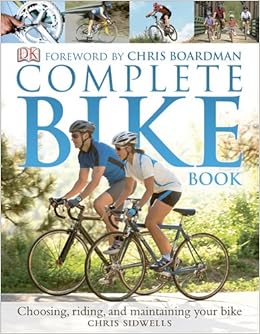
The third tome is currently in my son’s possession as he is also picking up the cycling bug. My intent is to look more into bicycle maintenance, and Howard Zinn’s works tend to come on top of the list. At Kinokuniya Orchard Road however, I found Zinn’s works too dry and the diagrams too technical and wanted more of a dummies guide. Even the Dummies book did not satisfy my search. Perusing the shelves further, I chanced upon Dorling Kindersley’s “Complete Bike Book” by Chris Sidwells, although printed 9 years ago, remains the most comprehensive reference for all things cycling. It was the only book I found to have a reference to foldies, and numerous other types of bicycles that I did not know existed.


So there’s the round-up the the books I have been reading on cycling. Some of the other books I am considering are below:


Any book you’d like to recommend me to read?


Take care.


Wan